
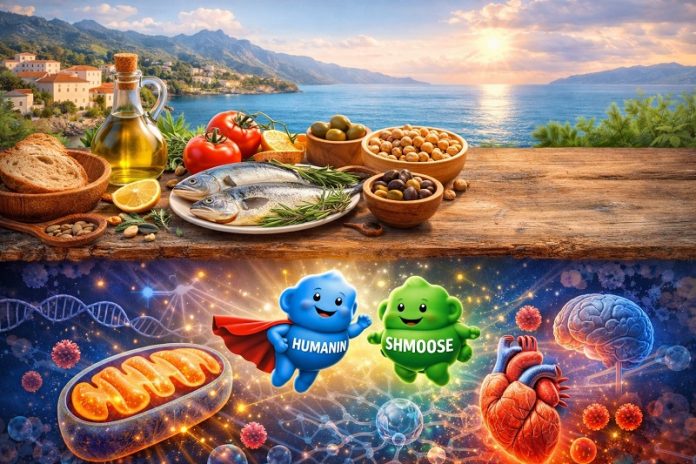
The Mediterranean diet has long been praised for helping people live longer and stay healthier. Now, a new study suggests that part of its power may come from tiny proteins inside our cells that respond to what we eat.
Researchers from the USC Leonard Davis School of Gerontology have found that people who closely follow a Mediterranean-style diet tend to have higher levels of two special molecules called humanin and SHMOOSE.
These are “microproteins” produced inside mitochondria, the parts of our cells that generate energy.
The study, published in Frontiers in Nutrition, suggests these microproteins may help protect against heart disease and brain disorders.
The Mediterranean diet focuses on foods like olive oil, fish, beans, fruits, and vegetables, while limiting processed foods and refined carbohydrates.
It has already been linked to lower risks of heart disease, diabetes, and cognitive decline. However, scientists have been trying to understand exactly how it works inside the body.
In this study, researchers analyzed blood samples from older adults with different eating habits. They found that those who followed the Mediterranean diet more closely had significantly higher levels of humanin and SHMOOSE.
At the same time, they showed lower levels of oxidative stress, a harmful process that damages cells and contributes to aging and chronic disease.
The researchers also noticed that certain foods seemed especially important. Olive oil, fish, and legumes were linked to higher levels of humanin, while olive oil and eating fewer refined carbohydrates were associated with higher SHMOOSE levels.
This suggests that specific foods in the diet may directly influence how mitochondria function.
Humanin has been studied for over 20 years and is known to support insulin sensitivity, protect the heart, and help maintain brain function. SHMOOSE is a more recently discovered protein that appears to protect brain cells.
Some research has shown that changes in SHMOOSE may increase the risk of Alzheimer’s disease, while normal levels may help defend against damage linked to the condition.
Another interesting finding involves an enzyme called Nox2, which produces harmful molecules known as reactive oxygen species.
The study found that higher levels of humanin were linked to lower Nox2 activity. This suggests that humanin may help reduce oxidative stress, providing another way the Mediterranean diet supports heart health.
Together, these findings point to a new way of understanding how diet affects the body. Instead of just looking at nutrients or calories, scientists are now exploring how food influences tiny biological signals that control aging and disease.
Although the study was relatively small, it opens the door to what researchers call “precision nutrition.” In the future, doctors may be able to measure these microproteins and use them to guide personalized diets that support healthy aging.
More research is needed to confirm these results and to see whether changing diet can directly increase these protective proteins. But for now, the study provides another strong reason to follow a Mediterranean-style diet.
It shows that healthy eating may work at a deep, cellular level—helping your body stay strong, protect your brain, and age more gracefully.
If you care about health, please read studies about the best time to take vitamins to prevent heart disease, and vitamin D supplements strongly reduce cancer death.
For more health information, please see recent studies about plant nutrient that could help reduce high blood pressure, and these antioxidants could help reduce dementia risk.